
Gustav Mahler a Jihlava
Gustav Mahler, a world-renowned composer and conductor of the early modern era, was born on July 7, 1860, in Kaliště near Humpolec. The Mahler family moved to Jihlava on October 22, 1860. At that time, Jihlava was the second largest city in Moravia, with a population of 17,000, mostly of German origin.
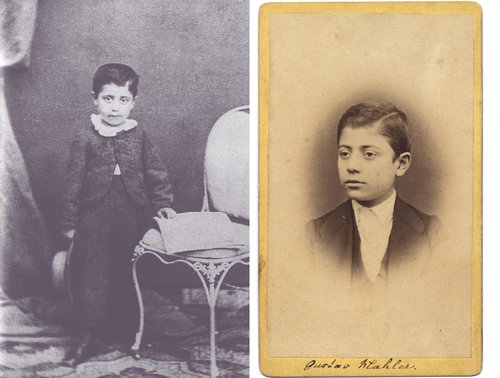
Gustav Mahler most likely received his elementary education at the parish boys’ school of St. Ignatius, located on what is today Křížová Street. Very little is known about this period of his life, as no school records have survived.
In the autumn of 1869, Mahler entered the German Grammar School at Hluboká Street No. 1, then called Im Jesuitengarten (from 1878 Tiefegasse). The building, dating from 1727 with an addition from the mid-19th century, still stands today and now houses the Jihlava Municipal Library.
During his grammar school years, Mahler formed friendships that lasted throughout his life. Among them were Josef Steiner, Guido Adler — later a distinguished Viennese musicologist — Emil Freund, Mahler’s legal adviser, and Theodor Fischer, son of Jihlava’s music teacher.
During his first semester, Mahler drew attention for his honesty when he returned a lost wallet containing a large sum of money — the story was publicly announced throughout the town and earned him recognition.
Mahler’s school performance was good in the early years — he ranked 22nd out of 49 students in his first year and 16th out of 40 in his second.
Mahler completed the sixth year of his grammar school studies. Through the recommendation of Gustav Schwarz, the manager of the Moravany estate, his father decided to send him to the Vienna Conservatory — on the condition that he would first finish grammar school and pass the final exams. "This is a born musician!", Julius Epstein at acceptance test during which Mahler also prided himself on his own creations.
For the next two years, Gustav attended the Jihlava grammar school as a private student, returning to the town for examinations and spending his holidays there.
To support the school, Mahler organized a benefit concert on 12 September 1876 in the large hall of the Czap Hotel to raise funds for teaching materials. His academic performance, however, declined — his final semester ended with four failing grades.
He withdrew from the regular examination date on 6 July 1877, but later appeared before the committee on 12 September, which allowed him to pass.
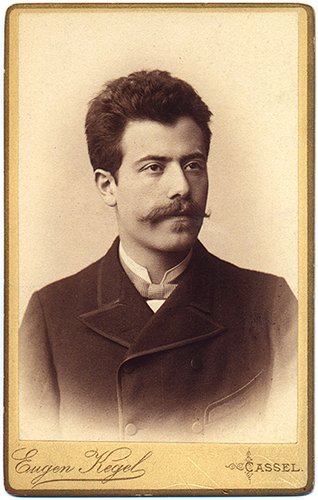
In October 1877, Mahler entered the Faculty of Philosophy at the University of Vienna, where he studied philosophy, history, and music history for two years. In June 1878, he successfully completed the Vienna Conservatory and in May 1880.
After completing his studies, Mahler accepted his first post in 1880 as conductor of the seasonal spa orchestra in Bad Hall, Upper Austria. He subsequently worked:
- 1881–1882 in Ljubljana,
- 1883 as Kapellmeister at the Royal Municipal Theatre in Olomouc,
- 1883–1885 in Kassel,
- 1885–1886 in Prague, at the German Royal Provincial Theatre under director Angelo Neumann,
where he achieved great success with Mozart’s Don Giovanni and Beethoven’s Ninth Symphony.
From 1886 to 1888, he served as second conductor at the Municipal Theatre in Leipzig, then from 1888 to 1891 as artistic director of the Royal Hungarian Opera in Budapest. This was followed by an engagement in Hamburg (1891–1897) as principal conductor of the Municipal Theatre.
By this time, Mahler was already recognized as a conductor of international stature, with successful guest appearances in numerous European cities – including London (June–July 1892).
In 1897, Mahler reached the pinnacle of his career when he became chief conductor and director of the Vienna Court Opera (Wiener Hofoper).
He collaborated with designers Heinrich Lefler and Alfred Roller, engaged the finest singers of his time, and demanded the highest artistic standards from both orchestra and stage productions.
His tenure from 1897 to 1907 marked a period of flourishing for the Vienna Opera and the beginning of a new era of opera staging – one that emphasized not only musical perfection but also dramatic and visual unity.
After leaving Vienna in 1907, Mahler accepted a position at the Metropolitan Opera in New York, where he remained until his death. From 1909, he also conducted the New York Philharmonic.
During his time in America, he performed not only in New York but also in Boston, Philadelphia, Pittsburgh, and Buffalo. Over the course of nearly 300 concerts, Mahler presented almost 400 works by around 90 composers.
He most frequently performed works by Richard Wagner, Ludwig van Beethoven, Franz Schubert, Johann Strauss, Pyotr Ilyich Tchaikovsky, Wolfgang Amadeus Mozart, and Felix Mendelssohn Bartholdy. Among Czech composers, his programs featured works by Bedřich Smetana and Antonín Dvořák (The Heroic Song).
He died on May 18 in Vienna.
More informations about Gustav Mahler www.mahler.cz
Photos: Fotoarchiv Muzea Vysočiny Jihlava

